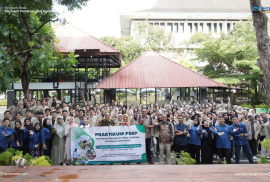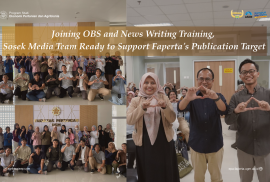
Yogyakarta, April 25, 2025-In order to improve content production and news writing skills, the Department of Agricultural Social Economics (Sosek) Media Team consisting of Adinda, Adhika, April, Inay, Mila, Mirda, Manda, Dinda, and Arsya participated in the “Open Broadcaster Studio (OBS) and Article Writing Training” organized by the Faculty of Agriculture UGM on Friday (25/04/2025). Located in Co-working Space 1 AGLC 6th Floor, this training was attended by the Faculty Media Team and Media Teams from various departments.
after report
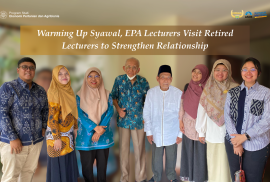
Yogyakarta, April 24, 2025—In the warm atmosphere of the month of Syawal, lecturers of the Agricultural Economics and Agribusiness Study Program (EPA) visited retired lecturers on Thursday, April 24, 2025. This activity is part of the Syawalan tradition, which is routinely carried out as a form of respect while strengthening the family ties between academicians across generations.
The group of EPA active lecturers visited the residence of several retired lecturers, including Mr. Ir. Sinarhadi and Dr. Ir. Djuwari, who, during their tenure, contributed a lot to building the development of the EPA Study Program to what it is today. The visit began with a prayer together and mutual forgiveness. The atmosphere of intimacy and kinship was thick throughout the visit.
Regina Claudia, an Agricultural Economics and Agribusiness Study Program student, is one of eight participants in the SUIJI-SLP Program representing UGM. The Six University Initiative Japan-Indonesia Service Learning Program (SUIJI-SLP) is a collaborative program between 3 universities in Indonesia (UGM, IPB, and Unhas) with 3 universities in Japan (Ehime University, Kagawa University, and Kochi University).
Regina said that the SUIJI program offers the opportunity to learn directly from the local community to understand their cultural values and lifestyles. “It turns out that learning Japanese culture directly from the Japanese people is mindful and meaningful!” she said.
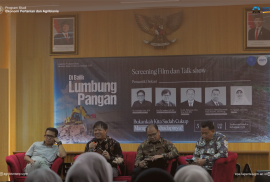
On December 5, 2024, the Auditorium of the Faculty of Forestry, Universitas Gadjah Mada (UGM) became the venue for a discussion and screening of a documentary film that raised important issues related to Indonesian food security. The event was organized by UGM Channel, with the documentary film title “Behind the Food Barn: Aren’t We Already Capable Enough to Face It?”.
This documentary film examines how people on the outermost islands of Indonesia struggle to maintain their food sovereignty with the challenges of globalization and climate change. After the screening of the film, an in-depth discussion was held. One of the discussion initiators at the event was Prof. Dr. Jamhari, S.P., M.P. as a professor from the Agricultural Economics and Agribusiness Study Program UGM who is also known as an expert in the field of food security.
Students of the 2022 Agricultural Economics and Agribusiness Study Program conducted an Agricultural Socio-Economic Assessment Practicum in Gunung Kidul Regency on November 1-4, 2024. The activity aims to provide students with information on the socio-economic conditions of farmers in Gunungkidul Regency through surveys and direct interviews with farmers.
The Agricultural Socio-Economic Assessment Practicum has a series of activities that allow students to have reliable academic abilities. After conducting field practicums by interviewing farmers, students then write the results of their studies in the form of a scientific report containing the general conditions of the area, characteristics of respondents, analysis of social conditions, analysis of costs, income, profits of farming businesses and the level of farmer welfare. This is expected to provide students with an overview of the portrait of farming businesses in Gunung Kidul Regency and the conditions of farmers’ households. To facilitate the implementation of the practicum, students are accompanied by a practicum assistant and a supervisor. The series of practicum activities are closed with an exam with a lecturer in the form of a presentation of the results of the analysis.
With the spirit of international collaboration, the EPA Study Program implements case-based learning in the agribusiness management course. The implementation of case-based learning is carried out to prepare EPA Study Program students to face global challenges. The class involves students from three countries, namely Indonesia, Japan, and South Korea. They succeeded in formulating innovative solutions to actual problems in the agribusiness sector.
The activity, which was held on November 26, 2024, carried two main themes, namely production risk management and human resource management. Students were divided into two large groups to explore each theme. By using a case-based learning approach, they were required to analyze real cases in the agribusiness industry, formulate problems, and design effective solutions from three countries, namely Indonesia, Japan, and South Korea.
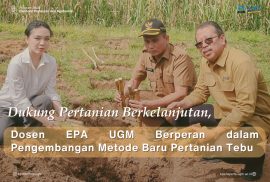
On October 29, 2024, the UGM Faculty of Agriculture, in collaboration with the Kana Cooperative and the Agam Regency Government, held counseling for sugarcane farmers in Kanagarian Lawang and Kebagarian Tigo Balai, Matur District. The event, which was held at the Lawang Village Head Office, aimed to introduce a new, more efficient method of planting sugarcane using the ringpit technique.
Low productivity and yield, as well as limited sugarcane supply, are problems faced by all sugarcane farmers. This has an impact on the less-than-satisfactory income of sugarcane farmers. Not only that, but the performance of the sugar industry, which relies on supplies from community sugarcane, is also not optimal. The low productivity and yield are caused by substandard cultivation techniques. The use of suboptimal inputs has an impact on low productivity and sugarcane yield. Therefore, the ringpit technique is a solution to increase the efficiency of water and nutrient absorption.
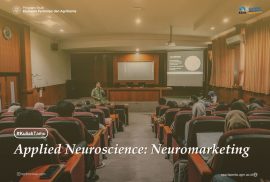
On Wednesday, October 30, 2024, the UGM Agricultural Economics and Agribusiness Study Program held a guest lecture on agribusiness management with the topic of neuroscience applications in neuromarketing. The resource person in this guest lecture was Bambang Iman Santoso, a neuro-enthusiast and Co-Founder of the Neuronesia Learning Center (NLC) at PT Neuronesia Neurosains Indonesia. The application of neuroscience in marketing is one of the important sciences that should be studied by an agricultural marketer because this science can perfect existing marketing science.
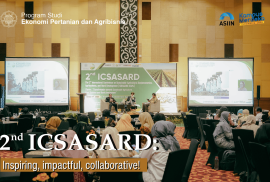
On October 17, 2024, the Department of Agricultural Socioeconomics, Faculty of Agriculture, Universitas Gadjah Mada (UGM) held the second International Conference on Sustainable Agricultural Socioeconomics, Agribusiness, and Rural Development (ICSASARD). This international conference was held to support the transformation of essential sectors to create a sustainable, resilient, and prosperous society.
ICSASARD 2024 covers 7 issues, including
1. Low Emission Development (LED) for sustainable agriculture
2. Information, Communication and Technology (ICT) for sustainable agriculture
3. Climate change and natural resources resilience for food systems
4. Sustainable food value chain
5. Food and nutrition security
6. Social transformation towards sustainable food system
7. Inclusive Rural Development
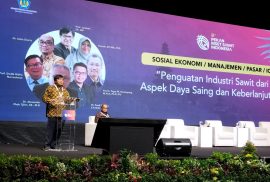
Prof. Jamhari, a distinguished expert in the Socio-Economics of Agriculture at UGM, was a key figure at the 8th Indonesian Palm Oil Research Week 2024. The event was held on 3-4 October 2024 at the Bali Nusa Dua Convention Center (BNDCC). The theme of the event was “Green Gold: Transforming Palm Oil Industry through Cutting-Edge Technologies”. This event is expected to introduce the latest research innovations on palm oil to stakeholders in the palm oil industry, such as the government, private sector, academics, and the wider community.