The contribution of academics from Universitas Gadjah Mada, particularly from the Faculty of Agriculture, was highlighted in a strategic discussion on strengthening the national food system through their participation in a focus group discussion (FGD) organized by Badan Pengawasan Keuangan dan Pembangunan. The FGD, titled “From Intervention to Independence: Assessing the Sustainability of KSPEAN as a Foundation for National Food System Independence,” was held on April 28–29, 2026, at the BPKP Regional Office of the Special Region of Yogyakarta.
article
The AIMS Fall 2025 program stands as a valuable international academic experience that contributes significantly to students’ global competence and academic development. Hosana Adel Ivory, a student of the Agricultural Economics and Agribusiness (EPA) Study Program, Faculty of Agriculture, Universitas Gadjah Mada (UGM), batch of 2022, had the opportunity to participate in this student exchange program during the odd semester of the 2025 academic year, from September 2025 to January 2026. The program was hosted by Ibaraki University, located in Ibaraki Prefecture, Japan, and involved students from the Faculty of Agriculture UGM across the 2022 and 2023 cohorts.
The Undergraduate Program of Agricultural Economics and Agribusiness, Department of Agricultural Socio-Economics, Faculty of Agriculture, Universitas Gadjah Mada, conducted a monitoring and evaluation session for the Impactful Internship Program on Thursday, April 9, 2026, from 1:00 to 3:00 PM (WIB), held online. This activity aimed to assess students’ progress across partner institutions while identifying achievements and challenges encountered during the program.
Based on the April monitoring and evaluation results, students generally demonstrated significant progress in their internship activities. Most participants have been actively involved in both operational and administrative tasks within their respective institutions. Their activities have become increasingly diverse, ranging from data management and administrative work to direct field engagement such as surveys, distribution monitoring, and community outreach.
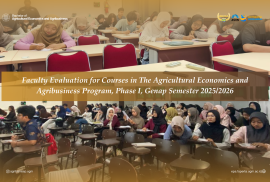
Summary of EDOM Results for the Agricultural Economics and Agribusiness Program, Phase 1, Genap Semester, Academic Year 2025/2026: http://ugm.id/EDOMTahapIEPAGenap20252026
Action Plan:
Improvements in learning quality are based on relatively lower-level indicators, such as the appropriateness of the workload and quizzes, the alignment of exam questions with the course material, students’ level of understanding, and their motivation to learn. Improvement efforts include updating the RPKPS, reminding students about it, implementing active learning methods like case-based learning and interactive discussions, and emphasizing the availability of digital materials on Google Classroom. Also, we are changing how we evaluate learning outcomes and reviewing exam questions with peers, while providing quicker and more helpful feedback to students. We will enrich course materials with real-world agribusiness cases and feature industry practitioners as guest speakers to enhance motivation and the relevance of learning. All these activities will be regularly monitored by the academic program and the quality assurance team as part of continuous quality improvement efforts to enhance student satisfaction and graduate learning outcomes.
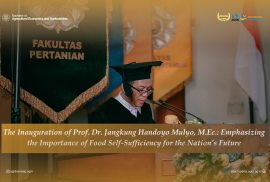
Yogyakarta, February 10, 2026 – Gadjah Mada University held the Professorial Inauguration Ceremony for Prof. Dr. Jangkung Handoyo Mulyo, M.Ec, as a Full Professor in the Field of Agricultural Economics and Agribusiness Management. This moment marks an important milestone in his academic journey and in his scholarly contributions to the development of Indonesia’s agricultural economy.
In his inaugural address, Prof. Jangkung emphasized that food self-sufficiency is a strategic foundation for national sovereignty and welfare. Food is not merely viewed as an economic commodity but also possesses strong social, political, and cultural dimensions. Amid global uncertainties such as climate change, supply chain disruptions, and price fluctuations, a self-reliant food system is key to ensuring a country does not depend on external parties. Additionally, he highlighted the importance of improving farmers’ welfare through enhanced market access, more efficient input costs, and adequate infrastructure support, using a cross-sectoral approach.
The Agricultural Economics and Agribusiness (EPA) Study Program at the Faculty of Agriculture conducted the Phase I Impactful Internship Monitoring session on Thursday, March 5, 2026, online with each student’s respective internship advisor. This activity plays a crucial role in ensuring that the internship program aligns with learning objectives and provides students with relevant real-world work experience.
The monitoring involved discussing students’ adaptation processes, the alignment of internship activities with their academic coursework, the variety of tasks performed, and the challenges encountered during the internship. In general, students demonstrated strong adaptability across various institutions, actively participating in administrative, operational, marketing, and field activities. However, several areas for improvement were also noted, including the need to align tasks with learning outcomes, strengthen technical skills, and maintain discipline in completing logbooks and preparing reports.
The Department of Agricultural Economics and Agribusiness (EPA) at Gadjah Mada University once again graduated its students during the Second Commencement Ceremony of the 2025/2026 Academic Year, held on February 25, 2026. During this ceremony, the EPA Department officially graduated four students who had completed their entire course of study.
During this period, one of the EPA Program graduates also achieved a notable accomplishment. Nadya Nur Fauzia, S.P., was honored as the department’s top graduate with a Cumulative Grade Point Average (CGPA) of 3.87. This accomplishment serves as a testament to her dedication and consistency in pursuing her studies and is expected to inspire other students.
The Department of Agricultural Economics and Agribusiness (EPA) at Gadjah Mada University is once again conducting a student placement program as part of the Impactful Internship Program for the Even Semester of the 2025/2026 academic year. This program officially began on February 10, 2026, and is being participated in by 84 sixth-semester students, who will undergo off-campus learning through hands-on workplace experience.
A total of 22 partner institutions are involved in this Impactful Internship Program, representing various sectors, including government agencies, State-Owned Enterprises (SOEs), private companies, and research institutions.
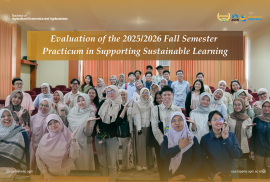
Yogyakarta, December 10, 2025 – The Evaluation of the Fall Semester Practicum for the 2025/2026 Academic Year was held offline at the MMA Auditorium, 3rd Floor, Agricultural Social Economics Building, Faculty of Agriculture. This activity marked the completion of the Agricultural Economics and Agribusiness Program Practicum for the Fall Semester 2025/2026. Lecturers and practicum assistants attended the event as a forum for reflection and continuous improvement of the practicum implementation over the course of one semester.
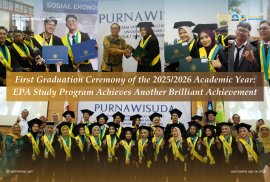
Yogyakarta, November 26, 2026 — The Agricultural Economics and Agribusiness (EPA) Study Program, Faculty of Agriculture, UGM, proudly welcomed 10 male graduates and 12 female graduates who officially earned their Bachelor of Agriculture (S.P.) degrees at the First Graduation Ceremony of the 2025/2026 Academic Year. This event marked a significant milestone for the entire academic community, as it once again highlighted numerous commendable achievements at both the departmental and faculty levels.